
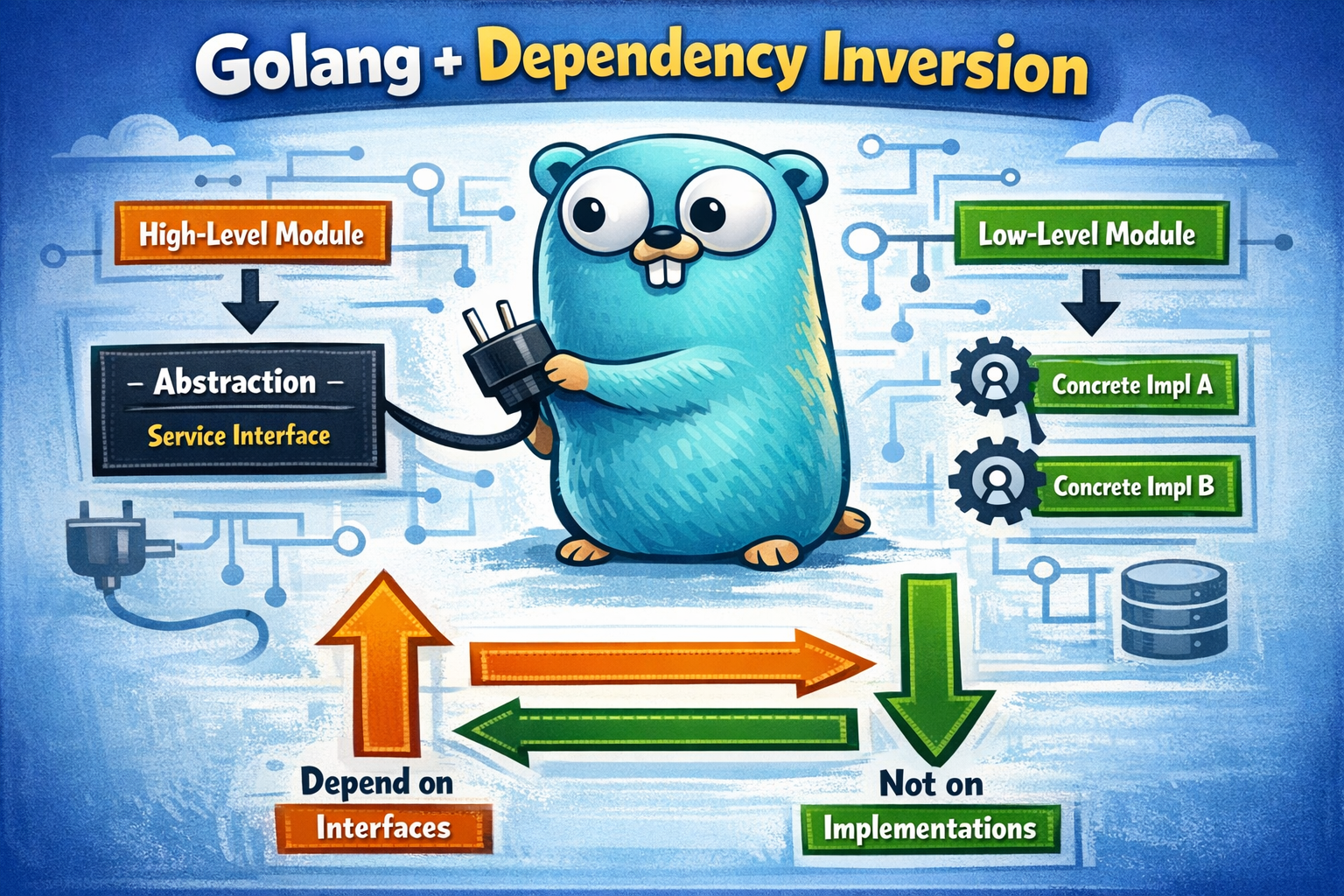
Dependency inversion is a fundamental principle in software design that enhances code cleanliness, maintainability, and extensibility. While not exclusive to Go, the way it manifests in this language is particularly accessible and effective. At its heart, dependency inversion asserts that high-level components should not rely directly on low-level modules. Instead, both should depend on abstractions, fostering a more adaptable architecture.
In practical Go development, this means crafting your business logic to interface with small abstractions that express what functionality is needed rather than focusing on how that functionality is implemented. This post dives into how to leverage this principle in Go, highlighting potential pitfalls and offering concrete examples to demonstrate correct implementation.
Using Dependency Inversion the Go Way
In Go, embracing dependency inversion is less about adhering to specific patterns and more about exercising simplicity and restraint. The Go ecosystem encourages starting with straightforward code and introducing abstractions only when they prove their value.
Let’s explore a basic example of a notification service:
type NotificationService struct {
  sender *EmailSender
}

func (s *NotificationService) Notify(msg string) error {
  return s.sender.Send(msg)
}
This implementation is clear and functional, but it excessively ties the NotificationService to the EmailSender. This can complicate testing and make it difficult to add new delivery methods later without modifying the service directly.
To mitigate this, a common strategy is to introduce an interface. However, how you design this interface is crucial. A more sensible approach is to define an interface that reflects the necessary behavior:
type Sender interface {
  Send(message string) error
}

type NotificationService struct {
  sender Sender
}

func (s *NotificationService) Notify(msg string) error {
  return s.sender.Send(msg)
}
Now, NotificationService relies on an abstraction called Sender, which defines behavior rather than a specific implementation. This change paves the way for diverse implementations, such as:
type EmailSender struct{}

func (e *EmailSender) Send(message string) error {
  // Logic to send an email
  return nil
}

type SMSSender struct{}

func (s *SMSSender) Send(message string) error {
  // Logic to send an SMS
  return nil
}
With this structure, NotificationService can work with any Sender implementation, enabling you to enhance the application without modifying existing code, thereby adhering to the principles of dependency inversion.
The key takeaway is that the focus should not merely be on the existence of an interface but on its context. In Go, you should shape interfaces based on the functionalities demanded by the client, rather than duplicating methods from an existing library.
A common mistake occurs when developers design interfaces that mirror existing libraries without encapsulating specific use cases. Consider this example:
type StorageClient interface {
  PutObject(bucket, key string, data []byte) error
}
While seemingly tidy, this is effectively a mere rebranding of a storage SDK. The service still has to comprehend buckets and keys, failing to simplify dependencies as intended.
Instead, a more constructive approach is to shift the focus and describe the intent behind the service’s needs:
type AvatarStore interface {
  Save(userID string, data []byte) error
}
Now, the service is unconcerned with storage intricacies, allowing it to focus purely on its functional requirements.
Moreover, keeping interfaces small is another valuable guideline in Go. Often, a one-method interface suffices:
type Clock interface {
  Now() time.Time
}
Minimal interfaces are easier to test, understand, and maintain, avoiding the pitfalls of bloated abstractions.
A subtle yet significant design pattern often seen in Go is the practice of accepting interfaces as parameters while returning concrete types:
func NewService(sender Sender) *NotificationService {
  return &NotificationService{sender: sender}
}
By accepting an interface, the service requires only the expected behavior; returning a concrete type grants the caller more flexibility. This design choice preserves usability while enhancing clarity in the API.
When to Use It (and When Not To)
While dependency inversion is a powerful principle, it can be misapplied if not approached carefully.
One widespread pitfall is to introduce interfaces prematurely. When there is only one concrete implementation in play, creating an abstraction can lead to over-engineering, where the interface becomes either too generic or overly coupled to the existing implementation.
A better approach is to wait for a need to arise before defining interfaces. The need for abstraction typically becomes apparent when you face challenges such as:
- Difficulties in testing due to tight coupling
- The requirement for multiple implementations in the future
- Mixing external details with core business logic
Once these pressures emerge, the right abstraction becomes clearer.
A helpful mental exercise is to consider whether the dependency can be summarized in a single, concise sentence. For example:
- “This service requires something that can send a message.”
- “This feature needs a method to load a user by their email.”
If you can articulate the need clearly, you are likely ready to define the interface. If the formulation feels vague or convoluted, it may be worth examining the design further before committing to an abstraction.
Closing Thoughts
In Go, dependency inversion is about making intentional design choices that enhance clarity without complicating the architecture. Quality Go code often begins with concrete implementations, applying abstractions only when genuinely necessary. This approach aligns with the understanding that effective abstractions arise from a deep grasp of the problem, rather than being tightly coupled to specific tools or libraries.
For developers dedicated to crafting clean and maintainable Go code, focus on articulating intent clearly, maintaining small interfaces, and avoiding premature abstractions. This discipline results in code that not only performs well but also remains intuitive and readily adaptable for years to come.
Enjoyed this article? Support my work with a coffee ☕ on Ko-fi.

