Buy Me a Coffee
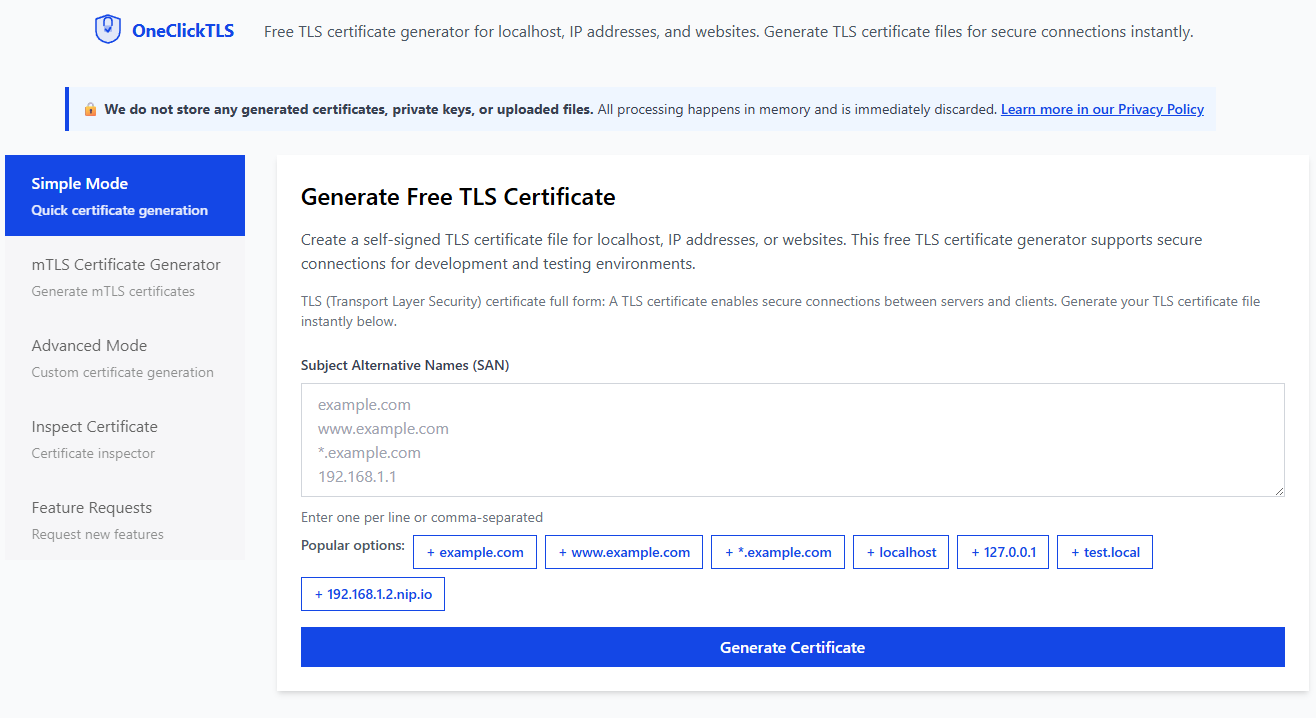
OneClickTLS online certificate generator

Introducing OneClickTLS: Generate Self-Signed TLS and mTLS Certificates Instantly

Introducing OneClickTLS: Generate Self Signed TLS and mTLS Certificates Instantly If you have worked with Kubernetes, Docker, microservices, or local HTTPS development, you already know how frustrating it is to generate self signed TLS certificates. Searching for OpenSSL commands, adjusting SAN values, fixing errors, and repeating the entire process again and again. After dealing with this pain for years, I finally built a tool that removes all the friction: https://oneclicktls.com ...

Debugging Go Programs in VSCode with Kubernetes

[Kubernetes] How to Debug Programs That Use the Kubernetes Client SDK in VSCode (Golang Example)

When you first work on a Go project that uses the Kubernetes client SDK, you might feel lost about how to debug it on your local environment. Don’t panic. It’s actually very simple once you understand what’s happening behind the scenes. I’ll walk you through how to make it work using VSCode as an example. The Common Confusion When your program is designed to run inside a Kubernetes cluster, it usually connects to the cluster using rest.InClusterConfig(). This configuration relies on the ServiceAccount token mounted at /var/run/secrets/kubernetes.io/serviceaccount/token. When you run the same program locally, that path doesn’t exist, and the SDK will fail to initialize with an error like: ...

Observer pattern illustration depicting a central subject with multiple observers connected

[Golang] Exploring the Observer Design Pattern with Code Example

Introduction Today, we will dive into understanding the Observer Design Pattern with a Golang code example. This pattern is a cornerstone of software design, promoting flexibility and reuse in code by managing dependencies effectively. What Is the Observer Pattern? The Observer pattern defines a one-to-many dependency between objects, ensuring that when one object (the Subject) changes its state, all its dependents (Observers) are automatically notified. This pattern is pivotal in creating an efficient and decoupled architecture. ...

Golang string parsing - Illustration depicting efficient string parsing in Go

[Golang] Efficient String Parsing in Go: Why strings.Cut is Your Go-To Function

Introduction When working with strings in Go, you might reach for the strings.Split function to get the first part of a string before a known delimiter. However, this approach isn’t optimal for performance-sensitive code. In this post, we’ll explore why using strings.Cut can be a better choice and discuss some efficient alternatives for string parsing in Go. The Inefficiency of strings.Split While strings.Split is a straightforward choice for separating strings by a delimiter, it comes with drawbacks: ...

[Golang/CVE] Why Your Playwright Tests Might Fail After Updating gorilla/csrf to Fix CVE-2024-24787

After updating the github.com/gorilla/csrf package in your Go backend from v1.7.2 to v1.7.3, you might suddenly notice that your Playwright tests start failing — specifically with 403 Forbidden responses. What Changed? This update addresses a security vulnerability: CVE-2024-24787. It’s a Golang backend issue, not related to WebSocket libraries like ws, despite what some GitHub advisory titles might misleadingly suggest. In v1.7.3, gorilla/csrf now strictly enforces same-site origin checks using the Origin and Referer headers. If these headers are missing or don’t match the expected host, CSRF validation fails, and the request is blocked with a 403. ...

[Golang] Why You Should Use errors.As Instead of Type Assertions err.(*MyError)

Introduction Go 1.13 introduced powerful features for error wrapping and introspection — namely errors.Is and errors.As. While it’s tempting to reach for traditional type assertions (e.g., err.(*MyError)), there’s a safer and more idiomatic tool for the job: errors.As. This post explains why you should use errors.As over type assertions, with clear examples for both concrete error structs and interfaces like net.Error. The Problem with Type Assertions Consider the old way of checking if an error is of a specific type: ...

[Web/Golang] What is CORS Error and How to Fix it in Golang

If you search Cors error, you can find tons of answers. But most of them are not clear enough to understand, especially you are new to web development. So I will explain what is Cors error and how to fix it in Golang. 1. What is Cors? CORS stands for Cross-Origin Resource Sharing. It is a security feature implemented by web browsers to control how web pages in one domain can request and interact with resources hosted on another domain. ...

[Golang] Retaining Specific Folders and Removing the Rest under A Target Path

Let’s consider a situation where there are multiple folders located under a specific path, and we only have the names of a few folders that we want to retain while removing the rest. For instance, the folder structure is presented below, with all entries being folders: ├── 123123 ├── 123456 ├── 123678 ├── 123789 ├── target-folder-1 └── target-folder-2 To tackle this scenario, we can approach it in two logical ways: Firstly, we can move the known folders to a different folder at the same level as the target path, as a temporary measure. Then, we can delete the target path and rename the temporary folder to match the path name. Alternatively, we can traverse through the target path and eliminate all folders except those we intend to keep. In this post, I will demonstrate how to implement the second method using Golang. ...

[ent/SQLite3] insert nodes to table "users": near "RETURNING": syntax error

Problem If you use ent with sqlite3 driver in your Golang project, you may encounter the following error when you try to insert a new record to the table. insert nodes to table "users": near "RETURNING": syntax error Analysis The error message indicates that the sqlite3 driver does not support the RETURNING clause. If you are using Golang sqlite3 package github.com/mattn/go-sqlite3 in your project. The issue may be caused by the version of the package. ...

[Golang/VSCode] Master Golang Debugging in VSCode: Step-by-Step Guide with Delve

Introduction If you are rocking VSCode as your IDE for Golang development and haven’t installed the debugger, I would recommend you to do it now. And Don’t worry, I’ve got your back. In this friendly guide, I’m going to walk you through the process of setting up and configuring the Golang debugger in VSCode. Step by step guide 1. Install the Debugger for Golang Delve, a fantastic open-source project, is your go-to debugging companion for Golang in VSCode. This powerful tool works like a charm on Linux, macOS, Windows, and FreeBSD. For this guide, we’ll focus on Windows, but the steps remain consistent across other platforms ...

DigitalOcean Referral Badge
Sign up to get $200, 60-day account credit !