
Introduction
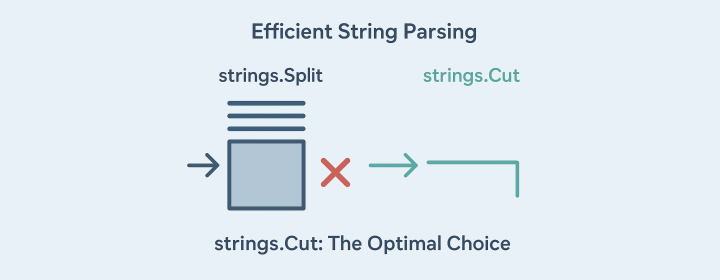
When working with strings in Go, you might reach for the strings.Split function to get the first part of a string before a known delimiter. However, this approach isn’t optimal for performance-sensitive code. In this post, we’ll explore why using strings.Cut can be a better choice and discuss some efficient alternatives for string parsing in Go.
The Inefficiency of strings.Split
While strings.Split is a straightforward choice for separating strings by a delimiter, it comes with drawbacks:
- Allocations: It allocates a slice for all parts of the split, even if you only need the first part.
- Full Scan: It scans the entire string, which is unnecessary if you only care about the initial segment.
Given these concerns, let’s look at better alternatives.
Efficient Alternatives
1. strings.Cut: The Ideal Choice
From Go 1.18 onwards, the strings.Cut function has been available. It effectively returns the first part of a string, the remainder, and a boolean to indicate if the separator was found—all without unneeded allocations.
package main

import (
    "fmt"
    "strings"
)

func main() {
    s := "hello:world"
    first, _, _ := strings.Cut(s, ":")
    fmt.Println(first) // "hello"
}
Why it’s better:
- Single Scan: It checks the string only once.
- Early Return: Stops after finding the first separator.
- No Slice Allocation: Unlike
strings.Split, it doesn’t create a slice with all tokens.
2. strings.Index: Fastest for Custom Needs
For scenarios requiring extreme optimization, or when dealing with custom separators, consider using strings.Index.
i := strings.Index(s, ":")
if i == -1 {
    first = s
} else {
    first = s[:i]
}
Pros:
- Zero Allocations: It doesn’t allocate memory for extra slices.
- Minimal Overhead: Directly obtains the index of the delimiter.
Cons:
- Readability: Slightly less intuitive compared to
strings.Cut.
⚠️ Avoid Using strings.Split for First Parts
Using strings.Split simply to get the first segment, like first := strings.Split(s, ":")[0], is inefficient because:
- Allocates a slice with all tokens.
- Scans the entire string unnecessarily.
- Overkill if you only need the first substring.
Recommendation Summary
| Method | Go Version | Allocations | Scans Whole String | Readability | Recommended |
|---|---|---|---|---|---|
strings.Split |
All | ✅ Allocates | ✅ Yes | 👍 Simple | ❌ No |
strings.Cut |
≥1.18 | ❌ None | ❌ No | 👍 Clear | ✅ Yes |
strings.Index |
All | ❌ None | ❌ No | ⚙️ Manual | ✅ For tight loops |
Conclusion
For most use cases, strings.Cut is the optimal choice for its idiomatic syntax, speed, and lack of unnecessary allocations. If you’re working on performance-critical code segments or using custom delimiters, strings.Index offers the highest efficiency. Make informed decisions to ensure your Go code remains both performant and readable.
Enjoyed this article? Support my work with a coffee ☕ on Ko-fi.

